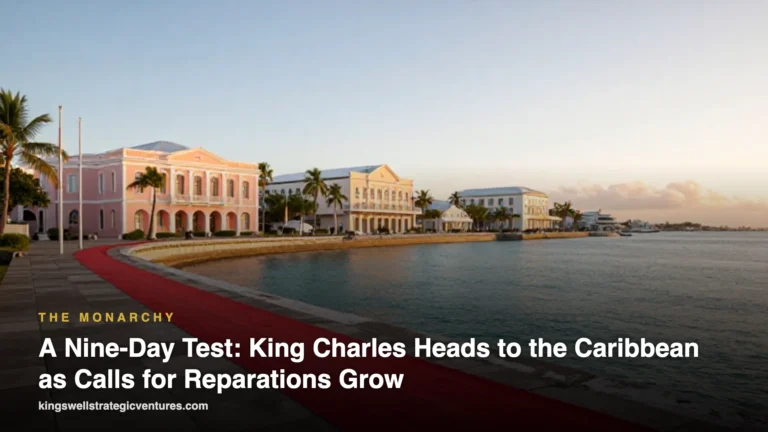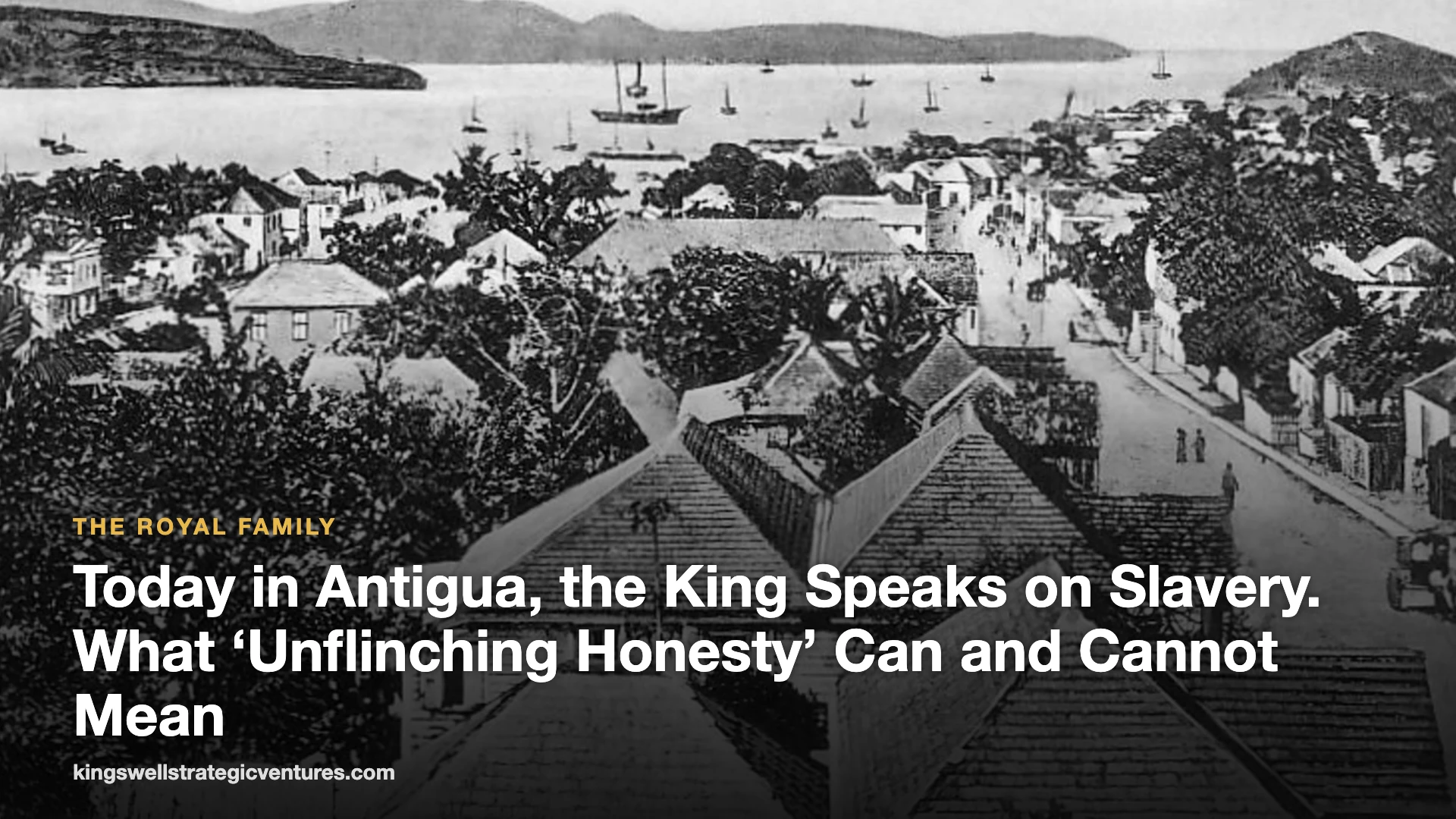
King Charles III is scheduled to open the Commonwealth Heads of Government Meeting in St. John’s, Antigua and Barbuda, today, Tuesday, Nov. 3, with a speech that Buckingham Palace says will confront Britain’s role in the transatlantic slave trade. It is the most closely watched address of his nine-day Caribbean tour, and it comes days after a significant shift in the British government’s own position on an apology.
The Palace has set expectations carefully. A spokesperson said the King would speak with “unflinching honesty, sincere sorrow” about the past, according to the BBC and IBTimes UK. The same briefing made clear what the speech will not include: a formal apology or any commitment to financial reparations, both of which the Palace considers matters for elected government rather than the Crown.
What is confirmed
- The setting: CHOGM runs Nov. 1 to 4 in St. John’s. The Commonwealth Secretariat lists the King’s address at the opening ceremony on Nov. 3, before leaders of the Commonwealth’s 56 member countries. Antigua and Barbuda is the smallest country ever to host the summit.
- The Palace line: A spokesperson said it would be inappropriate for the King to comment on the UK government’s policy position, as reported by both the BBC and IBTimes UK.
- The government shift: Prime Minister Andy Burnham said last week he was open to calls for a formal state apology for the slave trade and proposed a structured dialogue, the BBC and IBTimes UK reported. He ruled out compensation payments.
- No rewrite: The Palace was told of Burnham’s comments before they became public and made no changes to the King’s speech, according to the BBC; IBTimes UK, citing Sky News, reported the same.
- The tour so far: The King spent three days in the Bahamas, where he spoke of the suffering of the past, and two in Guyana, where he visited Independence Park, a site linked to the 1823 Demerara slave rebellion. He arrived in Antigua on Oct. 30. Queen Camilla joined him on Sunday, Nov. 1, for a church service in St. John’s before the country’s Independence Day celebrations, Hello! magazine reported. The visit ends Nov. 4.
What is reported but not settled
Burnham’s alternative to reparations, as described by IBTimes UK citing The Guardian, centers on working with international partners to ease debt pressure on vulnerable countries through longer repayment periods and lower interest rates, with former Prime Minister Gordon Brown asked to help. That remains a proposal, not a program. Antigua and Barbuda’s Prime Minister Gaston Browne welcomed the debt idea while holding to the Caribbean position on reparatory justice, and Barbados Prime Minister Mia Mottley welcomed dialogue while stressing that disagreement over reparations remains, IBTimes UK reported.
Earlier this year, African and Caribbean representatives endorsed a 19-point reparations plan at a meeting in Ghana, and CARICOM leaders agreed in July that the campaign should have a prominent presence at this summit, according to the summit’s Wikipedia entry, which cites regional coverage.
Why the words matter
This is not the first time the King has spoken about slavery to Commonwealth leaders. At the 2024 summit in Samoa, he acknowledged the painful aspects of the past while saying the past itself cannot be undone, a message many Caribbean leaders found insufficient, as NPR reported at the time. In 2022, as Prince of Wales, he spoke of his personal sorrow at the suffering caused by slavery when he opened that year’s summit in Rwanda.
Today’s speech will be measured against that record. “Sincere sorrow” goes further than 2024’s framing. The tour’s itinerary, with stops at places tied to enslavement and resistance, suggests the Palace intends the words to land as more than diplomatic courtesy.
The summit’s official agenda is broader than history. The Commonwealth Secretariat says leaders will meet investors on roughly $34 billion in investment-ready projects from 20 developing member countries, work toward a trade program to cut barriers within the Commonwealth, and discuss a common approach to sustainable debt and concessional finance. Those debt talks give Burnham’s proposal a natural venue.
The Kingswell Take
Kingswell sees today as a test of the constitutional division of labor at the heart of the modern monarchy. The King can acknowledge, grieve and lend moral weight; only ministers can apologize on behalf of the state or put money on the table. For years that division has allowed the Crown to say something without committing the country to anything. Burnham’s shift changes the dynamic: if the government is now open to an apology, the King’s words may be read less as a substitute for policy and more as a prelude to it.
That is a delicate place for the monarch to stand. Speak too softly and Caribbean leaders will hear a repeat of 2024. Speak too pointedly and critics at home will accuse the Palace of getting ahead of a political debate. The Palace’s insistence that the speech was not changed after Burnham’s comments is a signal that it wants the address judged on its own terms.
Kingswell also notes the long view. Several Caribbean realms continue to debate whether to keep the King as head of state. How the region receives today’s speech may matter more to the Crown’s future there than any single reform at the summit.
What it means for you
- Watch the exact wording. Phrases such as “sorrow,” “regret” and “acknowledge” carry different weight; an apology from the King himself is not expected.
- Follow the government track. Any formal apology or debt-relief plan would come from Downing Street, likely after the summit.
- Look for Caribbean reaction. Statements from Browne, Mottley and CARICOM in the next 48 hours will show whether the speech moved the conversation.
- Keep perspective. The summit ends Nov. 4; the reparations debate will continue long after the King flies home.
Test yourself
Where is the 2026 Commonwealth Heads of Government Meeting being held?
Answer: St. John’s, Antigua and Barbuda, from Nov. 1 to 4.
How has the Palace described the tone of the King’s speech?
Answer: “Unflinching honesty, sincere sorrow,” without a formal apology or reparations commitment.
Which 1823 event did the King’s Guyana visit recall?
Answer: The Demerara slave rebellion, at Independence Park.
What did Prime Minister Andy Burnham rule out?
Answer: Compensation payments, while saying he was open to a formal apology.
Discussion
- Should an apology for slavery come from the monarch, the government, or both?
- Is debt relief a meaningful alternative to reparations, or a way to avoid the question?
- Will today’s speech strengthen or weaken support for the monarchy in the Caribbean?
Sources
- BBC (via Yahoo News): King to address slavery during Commonwealth speech in Antigua on final leg of Caribbean tour (Oct. 31, 2026)
- IBTimes UK: King Charles slavery speech puts spotlight on Burnham’s apology talks and refusal to pay reparations (Nov. 1, 2026)
- Commonwealth Secretariat: CHOGM 2026 is our moment to shape what comes next (Oct. 26, 2026)
- Hello!: King Charles reunites with Queen Camilla on Caribbean tour (Nov. 1, 2026)
- Wikipedia: 2026 Commonwealth Heads of Government Meeting
- NPR: King Charles tells summit the past can’t be changed (Oct. 25, 2024)