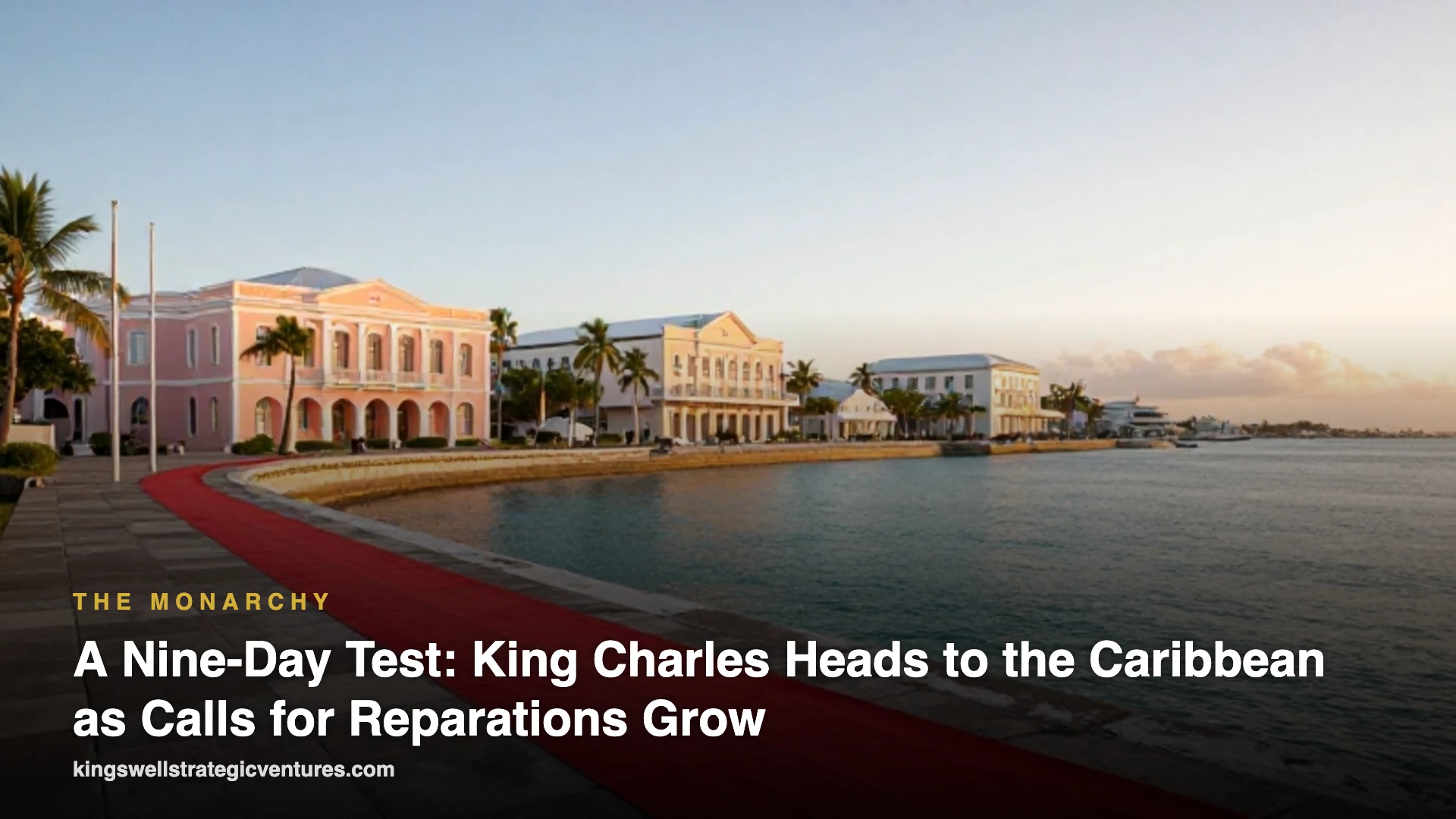
King Charles III and Queen Camilla begin a nine-day Caribbean tour on Tuesday, Oct. 27, visiting the Bahamas, Guyana and Antigua and Barbuda, where the King will attend the Commonwealth Heads of Government Meeting. It is his first trip to the region as monarch, and it arrives as governments and campaigners across the Caribbean press Britain for a formal apology for slavery and for reparations.
The itinerary
The tour runs through Nov. 4, according to HELLO! and the Associated Press. The Bahamas comes first, for three days, including a planned visit to Clifford Park, the site where the country’s flag was first raised at independence. Guyana follows for two days, with meetings with President Irfaan Ali and with elected leaders of Amerindian villages. The trip ends in Antigua and Barbuda, which hosts the Commonwealth Heads of Government Meeting, a gathering of leaders from the organization’s 56 member states expected to focus on climate, trade and development.
Jamaica is not on the itinerary. Buckingham Palace has framed the trip as a celebration of communities, cultures and nature within the Commonwealth.
The question hanging over the trip
Reparations and the legacy of slavery are expected to shadow every stop. The AP reported from the region on Monday that islanders are seeking reparations from Britain, a formal apology and greater independence, and that some Caribbean leaders want the issue to dominate the Antigua summit. Jamaica brought its reparations case to the King in early September, and its government is pushing to replace him as head of state, as Barbados did when it became a republic in 2021.
In the Bahamas, the national reparations committee criticized the visit outright. Its chair, Niambi Hall Campbell-Dean, put the question bluntly to the AP: “Why do we still have a King?” The Bahamas remains one of seven Caribbean countries that recognize Charles as head of state.
In Guyana, President Ali told the AP that the King has rightly acknowledged slavery as a dark chapter and that an apology would be the logical next step.
What the Palace has said
The King has previously described slavery as an appalling atrocity that left a lasting stain on history. According to HELLO!, palace officials say acknowledgment of past wrongs will be built into his program in all three countries, and he will deliver three speeches during the tour. A senior royal aide indicated the King would not avoid the darkest chapters of the past, while making clear that decisions on a formal apology or reparations rest with the British government, which has consistently rejected both. Acting on government advice, the King is not expected to issue an official apology.
Historian Sir Anthony Seldon, speaking to the BBC, called the tour “the biggest risk of his reign so far,” in part because so much of what happens on the ground lies outside the King’s control.
The Kingswell Take
Kingswell sees this tour as the clearest test yet of how the King balances constitutional limits with personal conviction. He cannot apologize on behalf of a government that has declined to do so, and he cannot pledge money he does not control. What he can do is choose his words, his venues and whom he meets. The decision to meet Amerindian village leaders in Guyana and to stand at Clifford Park in the Bahamas suggests a program designed to listen, not only to be seen.
The deeper story is the future of the realms. Barbados has already left, Jamaica is moving, and voices in the Bahamas are asking openly why the arrangement continues. A well-judged visit will not reverse that trend, but a poorly judged one could accelerate it. The Commonwealth summit in Antigua matters just as much: if reparations crowd out climate and trade on the agenda, the King will spend his final days in the region at the center of a debate he is constitutionally barred from settling.
The tour also comes a week after Prince Harry, in a GQ interview reported by ABC News, said he wants his relationship with his father and brother to work out. Family matters will not be on the official program, but they remain part of the backdrop. It is a demanding nine days for any monarch, and the speeches, more than the ceremonies, will define how the trip is remembered.
What it means for you
- Watch the speeches: the three planned addresses are where any shift in language on slavery and its legacy would appear.
- Follow the summit: the Commonwealth meeting in Antigua will show whether reparations become the defining agenda item for the organization’s 56 members.
- Read the realm debate carefully: six other Caribbean nations besides the Bahamas still have the King as head of state, and their choices will shape the Commonwealth for decades.
- Separate the roles: the King speaks; the government decides policy. Expect any concrete answer on reparations to come from Westminster, not the Palace.
Test yourself
1. Which three countries will the King visit on this tour?
Answer: The Bahamas, Guyana, and Antigua and Barbuda.
2. What major meeting is Antigua and Barbuda hosting?
Answer: The Commonwealth Heads of Government Meeting, with leaders of 56 member states.
3. Which Caribbean country became a republic in 2021?
Answer: Barbados.
4. Who decides whether Britain issues a formal apology or pays reparations?
Answer: The British government; the King acts on its advice.
Discussion
- Can a monarch meaningfully acknowledge historic wrongs without a formal apology from the government?
- Should reparations dominate the Commonwealth summit agenda, or share space with climate and trade?
- Will this tour slow or speed up moves by Caribbean realms toward becoming republics?
Sources
- Associated Press via CP24 — Caribbean seeks reparations and questions role of monarchy before King Charles III visits (Oct. 26, 2026)
- Associated Press via U.S. News & World Report — same report (Oct. 26, 2026)
- HELLO! — King Charles facing the biggest risk of his reign (Oct. 25, 2026)
- ABC News — Prince Harry opens up about returning to England (Oct. 20, 2026)
- Unofficial Royalty — Royal News Recap, Oct. 24-25, 2026
Leave a Reply