Category: News

  • $18 Billion in Eleven Deals: What Boston’s Biotech M&A Wave Tells Every Founder About Exits

    $18 Billion in Eleven Deals: What Boston’s Biotech M&A Wave Tells Every Founder About Exits

    The first half of 2026 was the most active deal window Boston’s biotech cluster has seen in years. According to MassBio’s annual Industry Snapshot, 11 Massachusetts companies were acquired for a reported $18 billion combined, and eight went public, matching 2024 and 2025 put together.

    Look underneath, though, and the market is selective. Venture dollars rose 25% to about $3.45 billion, yet the average seed round shrank to about $4.65 million while the average Series A grew to nearly $80 million. Capital is concentrating in companies that have already de-risked their science.

    Three lessons for founders in any industry

    1. Buyers pay for evidence, not potential. The deals going through are for companies with data in hand. In services or software, the equivalent is clean revenue, retention and margins you can document.
    2. Large strategics are the exit. Growth is concentrated in big players, such as Lilly, which nearly tripled its Massachusetts headcount. Know the three to five companies most likely to buy you and what problem you solve for them.
    3. Readiness is a process, not an event. Clean books, documented IP, contracts that can be assigned and a credible management bench take 12 to 24 months to build. Companies that start early sell on their timeline.

    The other side of the ledger

    Deal activity hasn’t translated into jobs. Massachusetts biopharma employment fell about 3,600 in 2025, the first decline in more than two decades of tracking, and nearly a third of the region’s lab space sat empty. Consolidation creates winners, but integration usually means cuts.

    The Kingswell view

    Whether you are preparing for a sale, a merger or a strategic partnership, the playbook is the same as in biotech: reduce the buyer’s risk before you ask for their money. Our strategy guides cover how to evaluate a partnership, document your assumptions and build an operating rhythm a buyer can trust.

    Sources: Boston.com (MassBio Industry Snapshot). Written by the Ecosystem Intelligence Desk.

  • A Nine-Day Test: King Charles Heads to the Caribbean as Calls for Reparations Grow

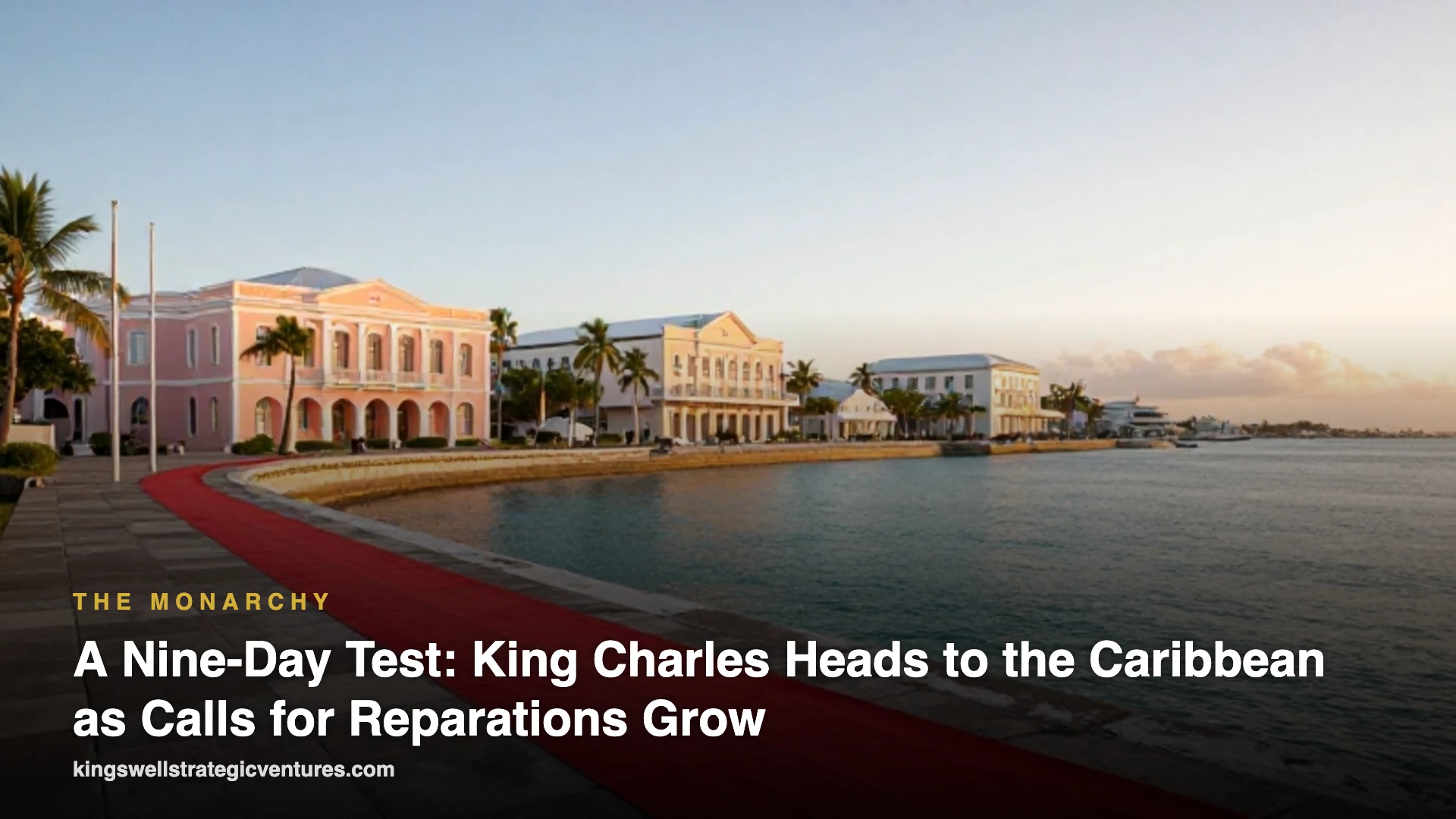
    A Nine-Day Test: King Charles Heads to the Caribbean as Calls for Reparations Grow

    King Charles III and Queen Camilla begin a nine-day Caribbean tour on Tuesday, Oct. 27, visiting the Bahamas, Guyana and Antigua and Barbuda, where the King will attend the Commonwealth Heads of Government Meeting. It is his first trip to the region as monarch, and it arrives as governments and campaigners across the Caribbean press Britain for a formal apology for slavery and for reparations.

    The itinerary

    The tour runs through Nov. 4, according to HELLO! and the Associated Press. The Bahamas comes first, for three days, including a planned visit to Clifford Park, the site where the country’s flag was first raised at independence. Guyana follows for two days, with meetings with President Irfaan Ali and with elected leaders of Amerindian villages. The trip ends in Antigua and Barbuda, which hosts the Commonwealth Heads of Government Meeting, a gathering of leaders from the organization’s 56 member states expected to focus on climate, trade and development.

    Jamaica is not on the itinerary. Buckingham Palace has framed the trip as a celebration of communities, cultures and nature within the Commonwealth.

    The question hanging over the trip

    Reparations and the legacy of slavery are expected to shadow every stop. The AP reported from the region on Monday that islanders are seeking reparations from Britain, a formal apology and greater independence, and that some Caribbean leaders want the issue to dominate the Antigua summit. Jamaica brought its reparations case to the King in early September, and its government is pushing to replace him as head of state, as Barbados did when it became a republic in 2021.

    In the Bahamas, the national reparations committee criticized the visit outright. Its chair, Niambi Hall Campbell-Dean, put the question bluntly to the AP: “Why do we still have a King?” The Bahamas remains one of seven Caribbean countries that recognize Charles as head of state.

    In Guyana, President Ali told the AP that the King has rightly acknowledged slavery as a dark chapter and that an apology would be the logical next step.

    What the Palace has said

    The King has previously described slavery as an appalling atrocity that left a lasting stain on history. According to HELLO!, palace officials say acknowledgment of past wrongs will be built into his program in all three countries, and he will deliver three speeches during the tour. A senior royal aide indicated the King would not avoid the darkest chapters of the past, while making clear that decisions on a formal apology or reparations rest with the British government, which has consistently rejected both. Acting on government advice, the King is not expected to issue an official apology.

    Historian Sir Anthony Seldon, speaking to the BBC, called the tour “the biggest risk of his reign so far,” in part because so much of what happens on the ground lies outside the King’s control.

    The Kingswell Take

    Kingswell sees this tour as the clearest test yet of how the King balances constitutional limits with personal conviction. He cannot apologize on behalf of a government that has declined to do so, and he cannot pledge money he does not control. What he can do is choose his words, his venues and whom he meets. The decision to meet Amerindian village leaders in Guyana and to stand at Clifford Park in the Bahamas suggests a program designed to listen, not only to be seen.

    The deeper story is the future of the realms. Barbados has already left, Jamaica is moving, and voices in the Bahamas are asking openly why the arrangement continues. A well-judged visit will not reverse that trend, but a poorly judged one could accelerate it. The Commonwealth summit in Antigua matters just as much: if reparations crowd out climate and trade on the agenda, the King will spend his final days in the region at the center of a debate he is constitutionally barred from settling.

    The tour also comes a week after Prince Harry, in a GQ interview reported by ABC News, said he wants his relationship with his father and brother to work out. Family matters will not be on the official program, but they remain part of the backdrop. It is a demanding nine days for any monarch, and the speeches, more than the ceremonies, will define how the trip is remembered.

    What it means for you

    • Watch the speeches: the three planned addresses are where any shift in language on slavery and its legacy would appear.
    • Follow the summit: the Commonwealth meeting in Antigua will show whether reparations become the defining agenda item for the organization’s 56 members.
    • Read the realm debate carefully: six other Caribbean nations besides the Bahamas still have the King as head of state, and their choices will shape the Commonwealth for decades.
    • Separate the roles: the King speaks; the government decides policy. Expect any concrete answer on reparations to come from Westminster, not the Palace.

    Test yourself

    1. Which three countries will the King visit on this tour?

    Answer: The Bahamas, Guyana, and Antigua and Barbuda.

    2. What major meeting is Antigua and Barbuda hosting?

    Answer: The Commonwealth Heads of Government Meeting, with leaders of 56 member states.

    3. Which Caribbean country became a republic in 2021?

    Answer: Barbados.

    4. Who decides whether Britain issues a formal apology or pays reparations?

    Answer: The British government; the King acts on its advice.

    Discussion

    1. Can a monarch meaningfully acknowledge historic wrongs without a formal apology from the government?
    2. Should reparations dominate the Commonwealth summit agenda, or share space with climate and trade?
    3. Will this tour slow or speed up moves by Caribbean realms toward becoming republics?
  • “I Want It to Work Out”: Harry’s Olive Branch, and Why the Palace Has Reason to Take It

    “I Want It to Work Out”: Harry’s Olive Branch, and Why the Palace Has Reason to Take It

    Prince Harry has said plenty about his family over the past five years. This time he said something different: he wants it fixed.

    In a GQ interview published Tuesday, the Duke of Sussex was asked whether he grieves his relationship with King Charles III and Prince William. He said yes, and that he hopes to repair it, putting it simply: “I want it to work out.” He framed family conflict as something most people can relate to, and said reconciling means being willing to let go of the past.

    The move that changed the math

    The comments come about two months after Harry, Meghan and their children, ages 5 and 7, moved back to the U.K. in August. Harry said the move was about being closer to family and letting the children experience life in Britain, and that it happened when circumstances lined up rather than after long planning.

    Proximity hasn’t yet turned into reunion. The family isn’t known to have seen the King or William in person since the move, and the brothers haven’t appeared together publicly since August 2024. When Harry also remarked that “some people don’t want it to work out,” a spokesperson quickly said the line was not about his family.

    The strategic read

    At Kingswell we look at institutions the way we look at companies, and the monarchy is a brand that depends on public trust. Seen that way, a reconciliation has clear upside for the Palace:

    • Momentum to protect. The King’s state visit to the U.S. in April, his first and the first by a British monarch since 2007, landed well. A YouGov poll found 74% of Britons thought he handled it well. A public family thaw would extend that goodwill.
    • Lower ongoing cost. Every new interview or memoir excerpt reopens the story. A private settlement ends the cycle.
    • Succession clarity. A visibly united family strengthens the transition narrative around William.

    The risk runs the other way too. A reconciliation that looks staged, or that falls apart in public, would be worse than continued distance. Expect any real progress to happen quietly, with private meetings before any shared public appearance.

    What to watch

    Remembrance Sunday on Nov. 8 and the Christmas season are the traditional moments when royal family presence is most visible. Whether Harry has any role in either will be the clearest signal yet.

    Sources: ABC News (GQ interview) · Wikipedia: 2026 state visit. Written by the Ecosystem Intelligence Desk.

  • At Windsor, the King Hosts Oman’s Sultan as Hormuz Shapes the Agenda

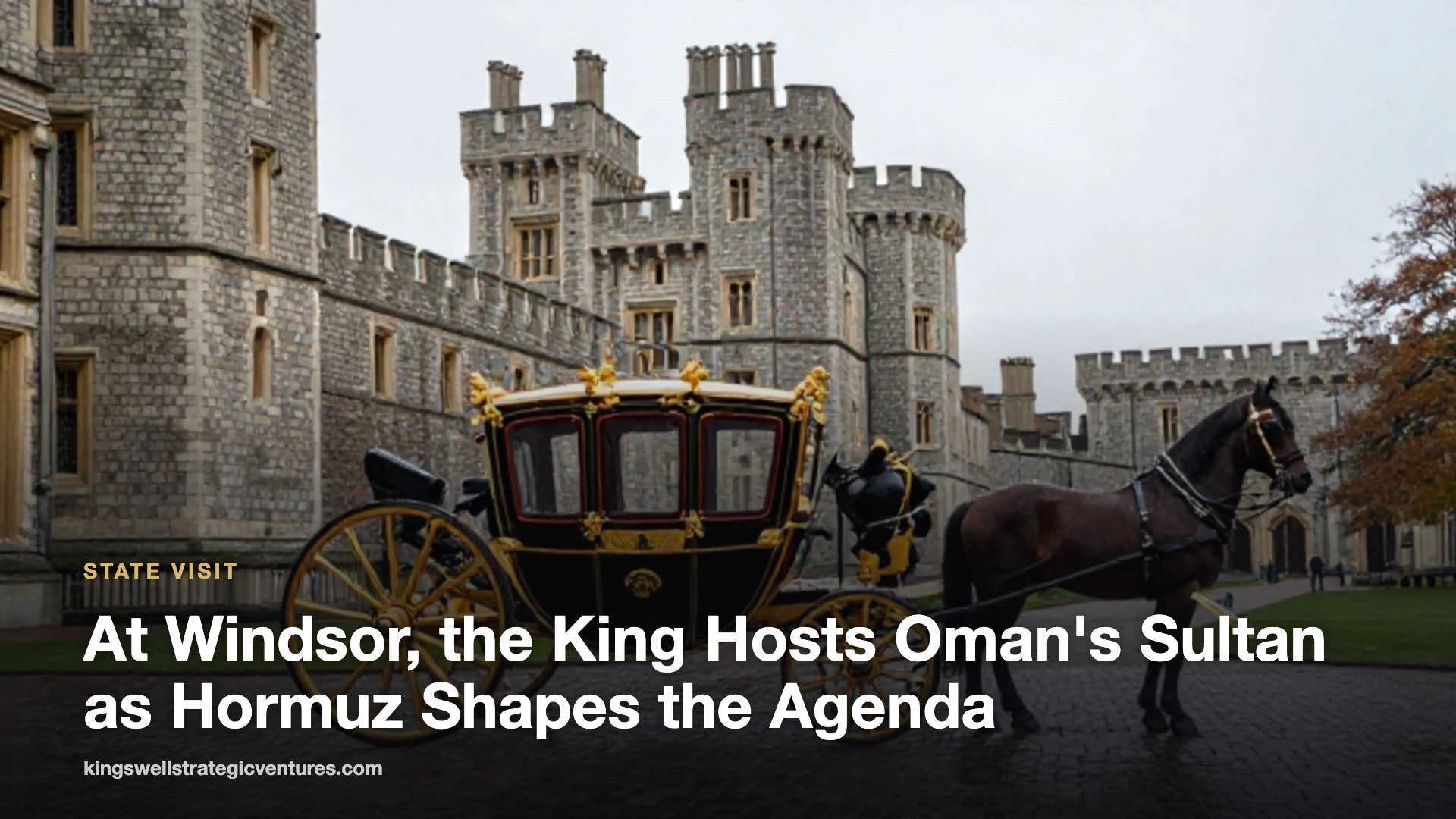
    At Windsor, the King Hosts Oman’s Sultan as Hormuz Shapes the Agenda

    King Charles III welcomed Sultan Haitham bin Tarik of Oman to Windsor Castle on Tuesday, Oct. 20, 2026, for the first state visit by an Omani ruler in 44 years, using a rain-soaked carriage procession and a banquet speech to honour the Gulf state at the centre of efforts to keep the Strait of Hormuz open.

    A ceremonial welcome in the rain

    The royal household announced the visit on Sept. 3, stating that the Sultan had accepted the King’s invitation to make a state visit from Tuesday, Oct. 20, to Thursday, Oct. 22, hosted by the King and Queen at Windsor Castle. It is the first by an Omani sultan since March 1982, when Queen Elizabeth II received Sultan Qaboos bin Said.

    On the morning of Oct. 20, the Prince of Wales met the Sultan at his London residence on the King’s behalf and accompanied him to Windsor, according to ITV News and The National. Royal gun salutes were fired, and the King and the Sultan rode in a horse-drawn carriage through the town to the castle, the Associated Press reported, with the route lined by members of the armed forces. In the castle quadrangle, the two inspected a guard of honour. Queen Camilla and the Princess of Wales also took part in the welcome.

    Later in the day, the Sultan viewed a selection of items from the Royal Collection tied to the long relationship between the two countries, Agence France-Presse and The National reported. The Sultan had last seen the King privately at Windsor in the summer of 2025.

    A banquet speech with a strategic message

    That evening, about 160 guests attended the state banquet at Windsor, including Prime Minister Andy Burnham, at his first state banquet since taking office, and the chief executives of Shell, BP and Airbus, according to AFP and Al Jazeera. The guest list itself said something about the visit’s purpose: energy, aerospace and finance sat alongside the royal family.

    In his speech, the King praised Oman’s role as a mediator and its efforts to help reopen the Strait of Hormuz, the narrow waterway on Oman’s border through which a large share of the world’s seaborne oil normally passes. He commended what AFP reported he called Oman’s “constructive neutrality,” and he described the sultanate as “one of Britain’s oldest allies,” according to The National. The Press Association reported that he spoke of the “enduring friendship” between the two countries.

    The Sultan answered with a line that summed up his country’s position. Oman “has chosen a different path, an independent path” in a conflict-prone region, he said, according to Al Jazeera, adding that Britain had been a friend along the way.

    Why Oman, and why now

    The setting is a war. Since fighting involving the United States and Iran began in late February, Oman has mediated between Washington and Tehran while trying to remain neutral, according to the AP and AFP. Shipping through Hormuz has been badly disrupted. Oman also hosts a long-standing British military presence at the port of Duqm on the Arabian Sea, which supports Royal Navy operations across the Gulf region.

    Burnham’s office said he spoke with the Sultan on Monday, Oct. 19, about the situation in the strait, the AP reported, and the two had first discussed restoring freedom of navigation there in July, shortly after Burnham became prime minister, according to The National and ITV News.

    Downing Street and the money

    The government side of the visit came on Wednesday, Oct. 21, when the Sultan held talks with Burnham at Downing Street. According to the Prime Minister’s Office and the Foreign Office, the two sides announced more than £1 billion in new investment and a set of agreements:

    • An agreement to accelerate two-way investment, building on the 2022 UK-Oman Sovereign Investment Partnership, under which Oman has invested £1.7 billion in Britain. Priority sectors include renewable energy, technology, critical minerals, space, healthcare and financial services.
    • A memorandum with UK-founded infrastructure company Yamna to build a large artificial-intelligence data centre in Salalah, with a first phase expected to exceed £1 billion and support more than 100 skilled jobs in Britain.
    • An increase in UK Export Finance’s capacity for British exports to Oman to as much as £7 billion.
    • A maritime cooperation memorandum with the Omani Maritime Security Centre on information-sharing.
    • Cooperation between the UK Space Agency and the Omani government, and the return of the Chevening scholarship programme to Oman, with applications opening in August 2027.

    Both leaders agreed that the strait must stay open to ease pressure on global supply chains and household costs, according to The National’s account of the Prime Minister’s Office readout. Burnham said the two countries are “leading with our values and creating opportunities for people in both our countries,” Gulf News reported. The Sultan then addressed business leaders at a banquet in the City of London, and on Thursday visited start-ups in East London working in space, healthcare and AI, The National reported.

    Windsor as the stage, and the noise around it

    Windsor has become the default setting for incoming state visits while Buckingham Palace undergoes its long-running refurbishment, as it was for President Donald Trump’s state visit in September 2025. This was also the first incoming state visit since the Duke and Duchess of Sussex returned to live in the United Kingdom, ITV News noted; the couple are not working members of the royal family and had no role. Coverage of the banquet also competed with an interview, published in the same news cycle, in which Prince Harry said he wants things to work out with his family, the Press Association noted.

    The Kingswell Take

    State visits are often read as pageantry. This one was an instrument of policy, and every element was arranged to say so. The King’s speech carried the government’s message on Hormuz in language a head of state can use and a minister cannot; the banquet seating put the chief executives of Britain’s energy and aerospace champions within conversation distance of the Sultan; and the commercial agreements were ready for signature the next morning in Downing Street.

    For Britain, the return is access: to a mediator both Washington and Tehran will talk to, to a naval facility at Duqm outside the Gulf’s narrowest chokepoint, and to sovereign capital looking for a home. For Oman, the return is visibility and public validation of a neutral posture that a regional war has put under strain. The monarchy’s particular contribution is continuity. By calling Oman one of Britain’s oldest allies, the King framed the relationship in generations rather than electoral cycles, and with a prime minister only a few months into office, that continuity is part of what Britain is offering.

    The sectors named in the investment partnership, from renewables and critical minerals to space and healthcare, are the clearest guide to where Gulf capital intends to go in Britain next.

    What it means for you

    • Founders and investors in renewable energy, critical minerals, space, healthcare and financial services should note that these are now the named priorities of the expanded UK-Oman investment partnership.
    • Expect continued royal involvement in Gulf diplomacy; the King’s speech tied the monarchy directly to Britain’s Hormuz policy.
    • Windsor, not Buckingham Palace, will remain the stage for incoming state visits for now, which shapes where public ceremonial events can be seen.
    • Students in Oman will be able to apply for Chevening scholarships again from August 2027.

    Test yourself

    1. When did an Omani sultan last make a state visit to Britain before this one?

    Answer: In 1982, when Queen Elizabeth II hosted Sultan Qaboos bin Said.

    2. Which member of the royal family escorted the Sultan from London to Windsor?

    Answer: The Prince of Wales, acting on the King’s behalf.

    3. Where will the UK-founded company Yamna build an AI data centre under the new agreements?

    Answer: In Salalah, Oman, with a first phase expected to exceed £1 billion.

    4. What phrase did the King use to describe Oman’s diplomatic posture?

    Answer: Constructive neutrality, a reference to Oman’s role as a mediator trusted by opposing sides.

    Discussion

    1. Should a constitutional monarch deliver a speech that carries such a direct foreign-policy message about a live conflict?
    2. Do state visits deliver investment that would not otherwise happen, or do they mainly showcase deals already agreed?
    3. What does Windsor’s role as the permanent stage for state visits change about the public’s relationship with royal ceremony?
  • Six Weeks Home: Harry, Meghan and the Letter That Drew the Lines

    Royal Watch · October 12, 2026

    Six Weeks Home: Harry, Meghan and the Letter That Drew the Lines

    Six weeks after their return to Britain, the Sussexes are visible everywhere except one place. What the King’s letter says, what is confirmed, what is only reported, and why it matters.

    By Kingswell Strategic Ventures · 8 min read

    Six Weeks Home: Harry, Meghan and the Letter That Drew the Lines

    October 12, 2026. Six weeks ago, Prince Harry came home. He brought Meghan and their two children, enrolled the kids in British schools, and began showing up at rugby grounds and charity halls as if he had never left. What he has reportedly not done, at least in public, is sit down with his father. Between those two facts sits the most watched family relationship in the world, and a letter that quietly redrew the lines.

    The letter that drew the lines

    On September 7, the Associated Press reported that King Charles III had clarified the couple’s status in a letter sent on his behalf by the Lord Chamberlain, the most senior official in the royal household. It went to senior government and military officials and to the lord lieutenants, the King’s personal representatives across the country. Its message was precise:

    • Harry and Meghan remain non-working members of the royal family.
    • They will keep refraining from using their royal titles, as they have since stepping back in 2020.
    • Any charity work they do will be private.
    • Decisions about their security belong to the relevant police agencies, and requests involving courtesies or public funds “should be directed to Buckingham Palace.”

    The letter changed nothing on paper. It was written, in its own words, “to help avoid doubt or confusion.” The decision to put it in writing, and to send it so widely, told observers something else: the palace wanted no ambiguity about who represents the Crown, and some saw a quiet guard against any “parallel royal court.”

    Six weeks home: what we know, and what is only reported

    Royal coverage runs on anonymous sources, so here it is split cleanly.

    Confirmed:

    • The family returned to Britain on August 26.
    • Before the move, Charles and Camilla hosted Harry, Meghan and the children at Highgrove on July 10, the King’s first meeting with his grandchildren since 2022, as a palace source confirmed to Reuters.
    • On September 30, the couple’s spokesperson criticized photographers near the children’s school as an intrusion on their privacy.
    • Harry attended the Invictus Spirit Awards in Greenwich on September 17 and a Leicester Tigers rugby match on October 9.
    • Meghan met Malala Yousafzai on October 7. On October 11, a partnership was announced sending proceeds from her As Ever jams and teas to the Malala Fund.
    • The couple is expected in Nottingham on October 16, including a food bank and the youth organization Epic Partners, according to PEOPLE.

    Reported, not confirmed:

    • Page Six reports that Harry has not met his father in person since the return, though the two are believed to have spoken by phone several times.
    • The couple reportedly plans to stay in England at least through the school year and will not join the Sandringham Christmas gathering.
    • The couple’s representatives said they received insufficient notice of the September letter; palace sources disputed that.

    Security: the issue that never left

    Under every headline sits protection. Harry has fought a long legal battle over the loss of publicly funded police protection when the couple stepped back. Whether to restore round-the-clock security is not the palace’s call. It belongs to RAVEC, the Royal and VIP Executive Committee, a government panel. The letter made the same point in royal language: operational security is for the police. Living full time in Britain, with children in British schools, raises the stakes of that question every day.

    The King’s own calendar

    Charles, meanwhile, is working. He spent much of late summer in Scotland after his ceremonial welcome at Balmoral on August 18, and this week marked what was billed as the “next chapter” of Apple’s partnership with The King’s Trust, the charity he founded, during its 50th-anniversary year. Buckingham Palace has confirmed an overseas tour from October 27 to November 4 to the Bahamas, Guyana, and Antigua and Barbuda, including the Commonwealth Heads of Government Meeting.

    Kingswell’s Take: stewardship is a family business

    Our name nods to a crown, and we have written before about King Charles III as a profile in stewardship. This chapter is a test of exactly that.

    Clarity is a form of care. The Lord Chamberlain’s letter reads like a governance document because it is one. Every enduring institution, a monarchy or a company, has to answer the same questions: who speaks for us, who carries the brand, and who pays. Writing those answers down is not coldness. It protects everyone, including the people who sit outside the formal structure.

    Proximity is not reconciliation. Harry living a short drive from his father changes the logistics, not the relationship. Founders and families alike know the hardest gaps are not geographic.

    Watch the calendar, not the gossip. The Nottingham visit, the King’s Commonwealth tour and the Christmas plans will say more than any unnamed source. If a reunion happens, it will most likely come quietly, and only after the cameras have moved on.

    Test yourself: the Crown and the Sussexes

    Five questions on the facts. Tap to answer.

    Questions worth sitting with

    • Can a family institution draw firm lines and still leave the door open?
    • Should security for a non-working royal be judged by role or by risk?
    • If you led an organization with a high-profile member who stepped away, what would you put in writing?

    Sources

    Kingswell Strategic Ventures is an independent company with no affiliation to the Royal Household. Featured image: AI-generated illustration (DeepAI); it does not depict real people.

    Across the network