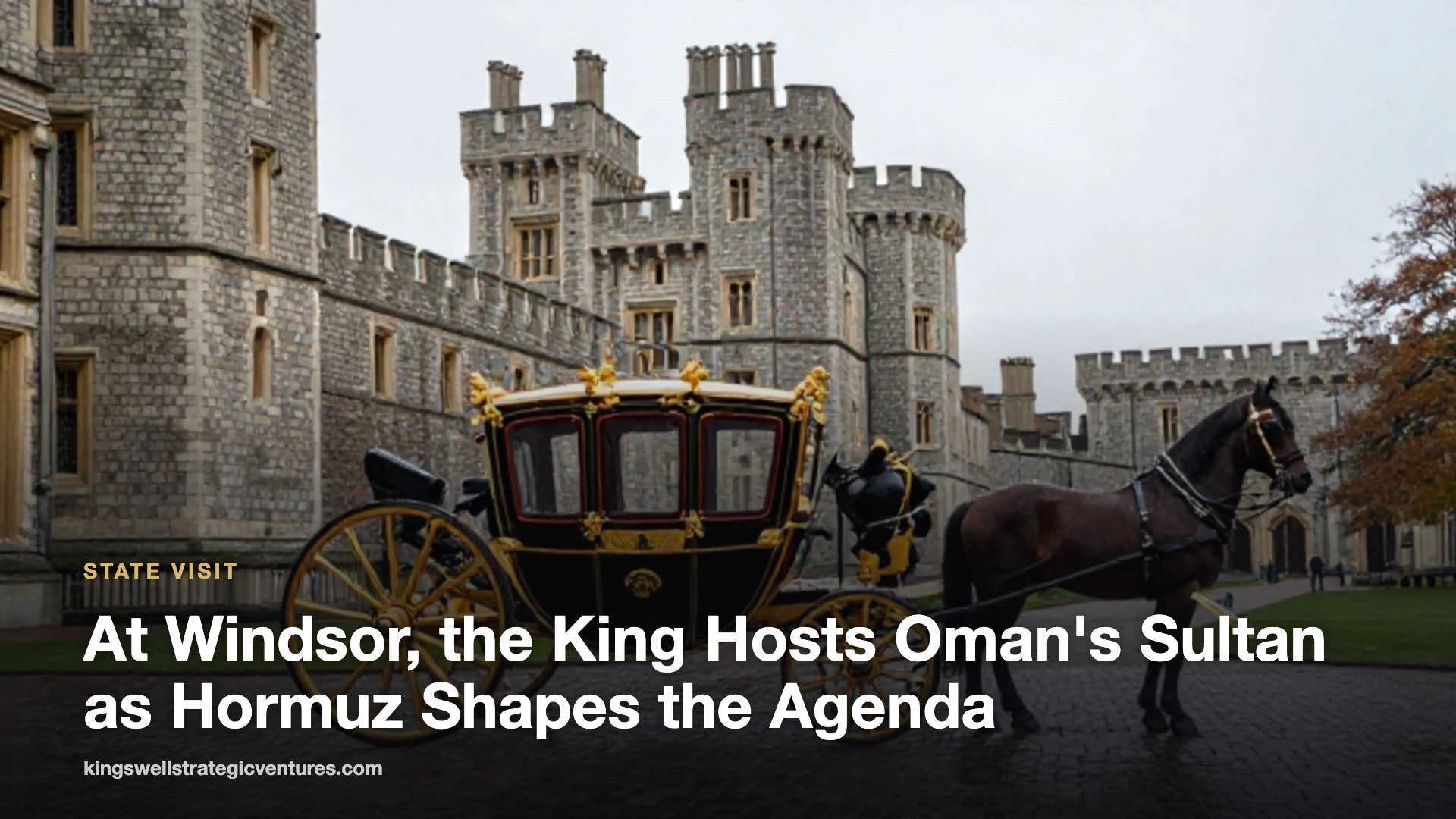
King Charles III welcomed Sultan Haitham bin Tarik of Oman to Windsor Castle on Tuesday, Oct. 20, 2026, for the first state visit by an Omani ruler in 44 years, using a rain-soaked carriage procession and a banquet speech to honour the Gulf state at the centre of efforts to keep the Strait of Hormuz open.
A ceremonial welcome in the rain
The royal household announced the visit on Sept. 3, stating that the Sultan had accepted the King’s invitation to make a state visit from Tuesday, Oct. 20, to Thursday, Oct. 22, hosted by the King and Queen at Windsor Castle. It is the first by an Omani sultan since March 1982, when Queen Elizabeth II received Sultan Qaboos bin Said.
On the morning of Oct. 20, the Prince of Wales met the Sultan at his London residence on the King’s behalf and accompanied him to Windsor, according to ITV News and The National. Royal gun salutes were fired, and the King and the Sultan rode in a horse-drawn carriage through the town to the castle, the Associated Press reported, with the route lined by members of the armed forces. In the castle quadrangle, the two inspected a guard of honour. Queen Camilla and the Princess of Wales also took part in the welcome.
Later in the day, the Sultan viewed a selection of items from the Royal Collection tied to the long relationship between the two countries, Agence France-Presse and The National reported. The Sultan had last seen the King privately at Windsor in the summer of 2025.
A banquet speech with a strategic message
That evening, about 160 guests attended the state banquet at Windsor, including Prime Minister Andy Burnham, at his first state banquet since taking office, and the chief executives of Shell, BP and Airbus, according to AFP and Al Jazeera. The guest list itself said something about the visit’s purpose: energy, aerospace and finance sat alongside the royal family.
In his speech, the King praised Oman’s role as a mediator and its efforts to help reopen the Strait of Hormuz, the narrow waterway on Oman’s border through which a large share of the world’s seaborne oil normally passes. He commended what AFP reported he called Oman’s “constructive neutrality,” and he described the sultanate as “one of Britain’s oldest allies,” according to The National. The Press Association reported that he spoke of the “enduring friendship” between the two countries.
The Sultan answered with a line that summed up his country’s position. Oman “has chosen a different path, an independent path” in a conflict-prone region, he said, according to Al Jazeera, adding that Britain had been a friend along the way.
Why Oman, and why now
The setting is a war. Since fighting involving the United States and Iran began in late February, Oman has mediated between Washington and Tehran while trying to remain neutral, according to the AP and AFP. Shipping through Hormuz has been badly disrupted. Oman also hosts a long-standing British military presence at the port of Duqm on the Arabian Sea, which supports Royal Navy operations across the Gulf region.
Burnham’s office said he spoke with the Sultan on Monday, Oct. 19, about the situation in the strait, the AP reported, and the two had first discussed restoring freedom of navigation there in July, shortly after Burnham became prime minister, according to The National and ITV News.
Downing Street and the money
The government side of the visit came on Wednesday, Oct. 21, when the Sultan held talks with Burnham at Downing Street. According to the Prime Minister’s Office and the Foreign Office, the two sides announced more than £1 billion in new investment and a set of agreements:
- An agreement to accelerate two-way investment, building on the 2022 UK-Oman Sovereign Investment Partnership, under which Oman has invested £1.7 billion in Britain. Priority sectors include renewable energy, technology, critical minerals, space, healthcare and financial services.
- A memorandum with UK-founded infrastructure company Yamna to build a large artificial-intelligence data centre in Salalah, with a first phase expected to exceed £1 billion and support more than 100 skilled jobs in Britain.
- An increase in UK Export Finance’s capacity for British exports to Oman to as much as £7 billion.
- A maritime cooperation memorandum with the Omani Maritime Security Centre on information-sharing.
- Cooperation between the UK Space Agency and the Omani government, and the return of the Chevening scholarship programme to Oman, with applications opening in August 2027.
Both leaders agreed that the strait must stay open to ease pressure on global supply chains and household costs, according to The National’s account of the Prime Minister’s Office readout. Burnham said the two countries are “leading with our values and creating opportunities for people in both our countries,” Gulf News reported. The Sultan then addressed business leaders at a banquet in the City of London, and on Thursday visited start-ups in East London working in space, healthcare and AI, The National reported.
Windsor as the stage, and the noise around it
Windsor has become the default setting for incoming state visits while Buckingham Palace undergoes its long-running refurbishment, as it was for President Donald Trump’s state visit in September 2025. This was also the first incoming state visit since the Duke and Duchess of Sussex returned to live in the United Kingdom, ITV News noted; the couple are not working members of the royal family and had no role. Coverage of the banquet also competed with an interview, published in the same news cycle, in which Prince Harry said he wants things to work out with his family, the Press Association noted.
The Kingswell Take
State visits are often read as pageantry. This one was an instrument of policy, and every element was arranged to say so. The King’s speech carried the government’s message on Hormuz in language a head of state can use and a minister cannot; the banquet seating put the chief executives of Britain’s energy and aerospace champions within conversation distance of the Sultan; and the commercial agreements were ready for signature the next morning in Downing Street.
For Britain, the return is access: to a mediator both Washington and Tehran will talk to, to a naval facility at Duqm outside the Gulf’s narrowest chokepoint, and to sovereign capital looking for a home. For Oman, the return is visibility and public validation of a neutral posture that a regional war has put under strain. The monarchy’s particular contribution is continuity. By calling Oman one of Britain’s oldest allies, the King framed the relationship in generations rather than electoral cycles, and with a prime minister only a few months into office, that continuity is part of what Britain is offering.
The sectors named in the investment partnership, from renewables and critical minerals to space and healthcare, are the clearest guide to where Gulf capital intends to go in Britain next.
What it means for you
- Founders and investors in renewable energy, critical minerals, space, healthcare and financial services should note that these are now the named priorities of the expanded UK-Oman investment partnership.
- Expect continued royal involvement in Gulf diplomacy; the King’s speech tied the monarchy directly to Britain’s Hormuz policy.
- Windsor, not Buckingham Palace, will remain the stage for incoming state visits for now, which shapes where public ceremonial events can be seen.
- Students in Oman will be able to apply for Chevening scholarships again from August 2027.
Test yourself
1. When did an Omani sultan last make a state visit to Britain before this one?
Answer: In 1982, when Queen Elizabeth II hosted Sultan Qaboos bin Said.
2. Which member of the royal family escorted the Sultan from London to Windsor?
Answer: The Prince of Wales, acting on the King’s behalf.
3. Where will the UK-founded company Yamna build an AI data centre under the new agreements?
Answer: In Salalah, Oman, with a first phase expected to exceed £1 billion.
4. What phrase did the King use to describe Oman’s diplomatic posture?
Answer: Constructive neutrality, a reference to Oman’s role as a mediator trusted by opposing sides.
Discussion
- Should a constitutional monarch deliver a speech that carries such a direct foreign-policy message about a live conflict?
- Do state visits deliver investment that would not otherwise happen, or do they mainly showcase deals already agreed?
- What does Windsor’s role as the permanent stage for state visits change about the public’s relationship with royal ceremony?
Sources
- Associated Press via Arab News — Sultan of Oman begins state visit to Britain as Gulf state plays pivotal role in Strait of Hormuz (Oct. 20, 2026)
- The Royal Family — Announcement of a State Visit by His Majesty Sultan Haitham bin Tarik, Sultan of Oman (Sept. 3, 2026)
- GOV.UK — Major investment to drive growth and jobs across Britain as Sultan of Oman visits UK (Oct. 21, 2026)
- Agence France-Presse via Inquirer — King Charles lauds Omani peace efforts on Sultan’s state visit (Oct. 21, 2026)
- Al Jazeera — King Charles welcomes Omani sultan, hails peace efforts in UK state visit (Oct. 21, 2026)
- Press Association via The Irish News — King bids farewell to Sultan of Oman after state visit (Oct. 21, 2026)
- ITV News — King and royal family to welcome Sultan of Oman for Windsor state visit (Oct. 19, 2026)
- The National — Sultan of Oman welcomed by King Charles for UK state visit (Oct. 20, 2026)
- The National — King Charles praises Oman’s efforts to keep Strait of Hormuz open (Oct. 21, 2026)
- The National — Sultan Haitham renews centuries-old trade links with London on state visit (Oct. 22, 2026)
- Gulf News — Oman and UK forge £1bn AI data centre deal, strengthen investment and security ties (Oct. 22, 2026)
- Reality Tea, citing People — Why the state visit is at Windsor Castle (Oct. 19, 2026)